Choosing a real estate SMS marketing platform is less about comparing feature lists than most buyers expect. The features are broadly similar across vendors. What separates platforms is whether your messages actually reach phones, how much volume you can send before carriers throttle you, and how well the tool fits the way your team already works.
This guide covers what these platforms do, the compliance rules that govern them, what texting really costs, and how to evaluate a vendor before you sign.
What is a real estate SMS marketing platform?
A real estate SMS marketing platform is software that lets agents, brokers, and investors send text messages to leads at scale, manage the replies in a shared inbox, and automate follow-up. It handles the parts that a personal phone cannot: sending at volume, carrier registration, opt-out tracking, dividing replies across a team, and syncing conversations to a CRM.
The category covers a wide range. Some tools are built for high-volume campaigns to large contact lists. Others are built for nurturing individual leads from a website or portal through a longer conversation. A few do both. The distinction matters more than any individual feature, because it determines how the platform handles list imports, consent records, and deliverability at volume.
Why do real estate teams use SMS instead of email or calls?
Texting sits between email and calling in both effort and intrusiveness. It reaches people who ignore unknown numbers and never open marketing email, and it lets one person hold dozens of conversations at once instead of one at a time on the phone.
For real estate specifically, three use cases dominate:
Speed to lead. A text sent within minutes of an inquiry gets a reply far more often than one sent hours later. Automation removes the delay entirely.
Follow-up over long cycles. Sellers often take months to decide. Drip sequences keep you present without manual effort.
Logistics. Showing confirmations, appointment reminders, and document nudges are short, time-sensitive, and well suited to text.
What SMS does not do well is replace relationship building. It opens conversations. It rarely closes them.
Which is why the platform needs a phone in it. When someone replies and wants to talk, you need to call them back from the same number they have been texting, without switching apps or exposing your personal line. That is a different capability from a power dialer. A dialer is built for working through a list at volume. One-to-one calling is for the moment a single conversation turns warm and a text thread stops being the right place for it. Most platforms in this category offer one or the other, and the two are easy to confuse on a feature list.
What are the main types of real estate SMS platforms?
Understanding the categories saves more time than reading feature comparisons, because each type solves a different underlying problem.
Purpose-built real estate messaging platforms handle sending, carrier registration, compliance, and reply management as one system. You get a working setup without assembling parts. This is the most common choice for teams whose primary channel is outbound text.
Data-first platforms with messaging attached lead with property records, filtering, and data enrichment. Messaging is a secondary capability, and in some cases requires connecting a separate SMS provider. Strong when your bottleneck is finding the right property owners rather than contacting them.
Dialer-first platforms with SMS added are built around calling, with texting as a supporting channel. Good if your team’s core motion is phone based.
General business texting tools serve every industry. They are usually cheaper and simpler, but lack real estate list handling, data enrichment, and the volume tolerance that high-volume real estate campaigns require.
API and DIY builds on providers like Twilio give you full control and the lowest per-message cost, at the price of building the interface yourself and managing your own carrier registration.
What features actually matter for real estate?
Most vendors list the same capabilities. These are the ones that change outcomes:
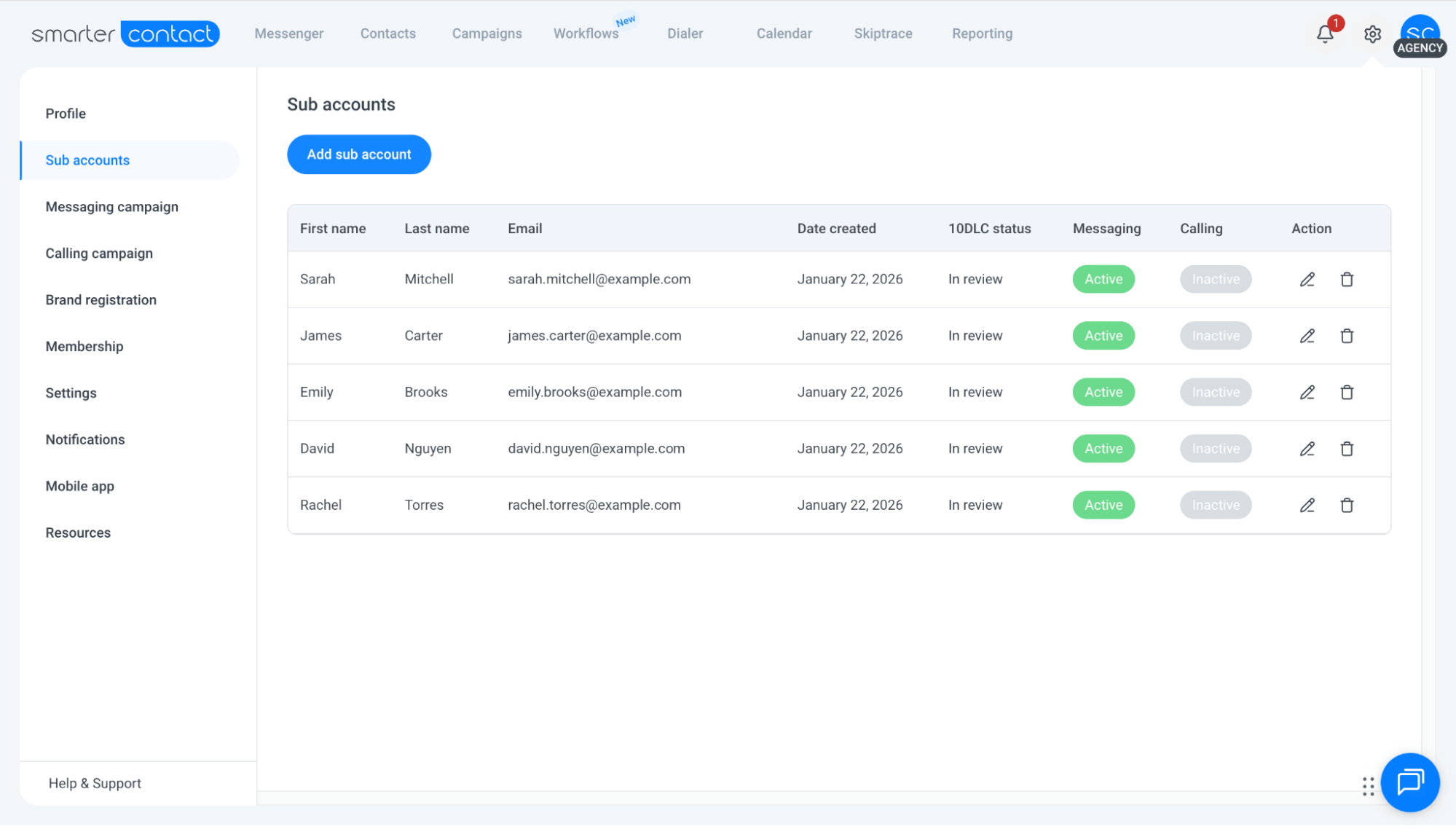
- A workable way to divide the inbox. Most accounts are run by one person, and a single shared inbox is fine at that size. The moment a second person steps in, you need a way to split the queue so nobody answers the same conversation twice and nothing sits untouched. Platforms solve this three ways: assigning conversations to an owner, letting each person filter to a defined slice using labels or tags, or giving each person a separate workspace entirely. Any of them works. What does not work is two people scrolling the same undifferentiated list.
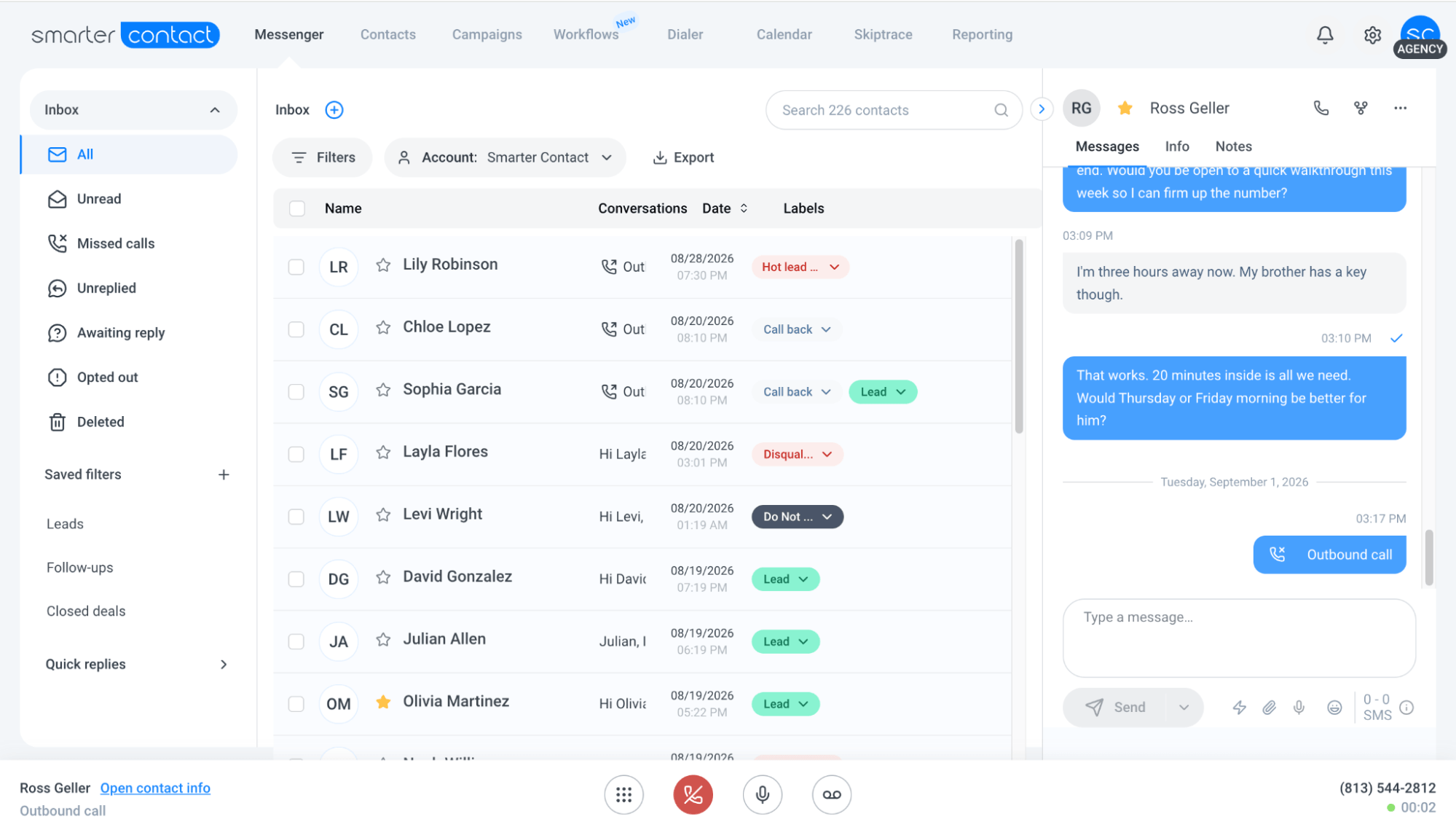
- One-to-one calling from your texting numbers. Separate from a power dialer. When a conversation warrants a call, you want to place it from the number the contact already recognizes, and have that call logged against the same record as the messages.
- Number management and rotation. Sending everything from one number concentrates risk. Distributing volume protects deliverability.
- Automated opt-out handling. Missing a STOP request is a compliance failure, not a minor bug.
- Consent capture wired into your lead flow. The strongest setups record consent the moment someone submits a form, send the compliance text automatically, and store that record against the contact. Knowing where and when each person opted in, and being able to produce that record later, is the difference between a defensible program and an expensive one. Doing it by hand is where consent trails go missing.
- Automated compliance texts that do not draw down your balance. The opt-in confirmation is a regulatory requirement, not a marketing message. Platforms that bill it as normal volume are charging you for compliance.
- Data enrichment. Turning a property list into usable phone numbers inside the platform saves a vendor relationship and a data handoff.
- Message personalization with merge fields. Identical messages sent at volume are a recognizable spam pattern to carriers.
- A CRM that fits your team size. Either the platform holds your pipeline itself, or it connects cleanly to the CRM that does. Both work. Running two systems that disagree does not.
- An account structure that matches how your business is organized. This is two separate questions. If you run several legal entities, each needs its own brand registration and carries its own volume ceiling, so you want them kept distinct but reachable from one place rather than through separate logins. Separately, if you run distinct books of business, markets, or team members that should not see each other’s contacts, look for sub-accounts: clean separate workspaces under a single subscription. Check whether sub-accounts share one message balance or hold their own, since that determines whether one busy workspace can drain the others.
- Quiet hours enforcement by contact time zone. Sending outside permitted windows is one of the easiest violations to commit accidentally.
Do you need A2P 10DLC registration to text leads?
Yes. Any business sending text messages to US mobile numbers from a standard 10-digit local number must register through The Campaign Registry. This is not optional and not something you can defer.
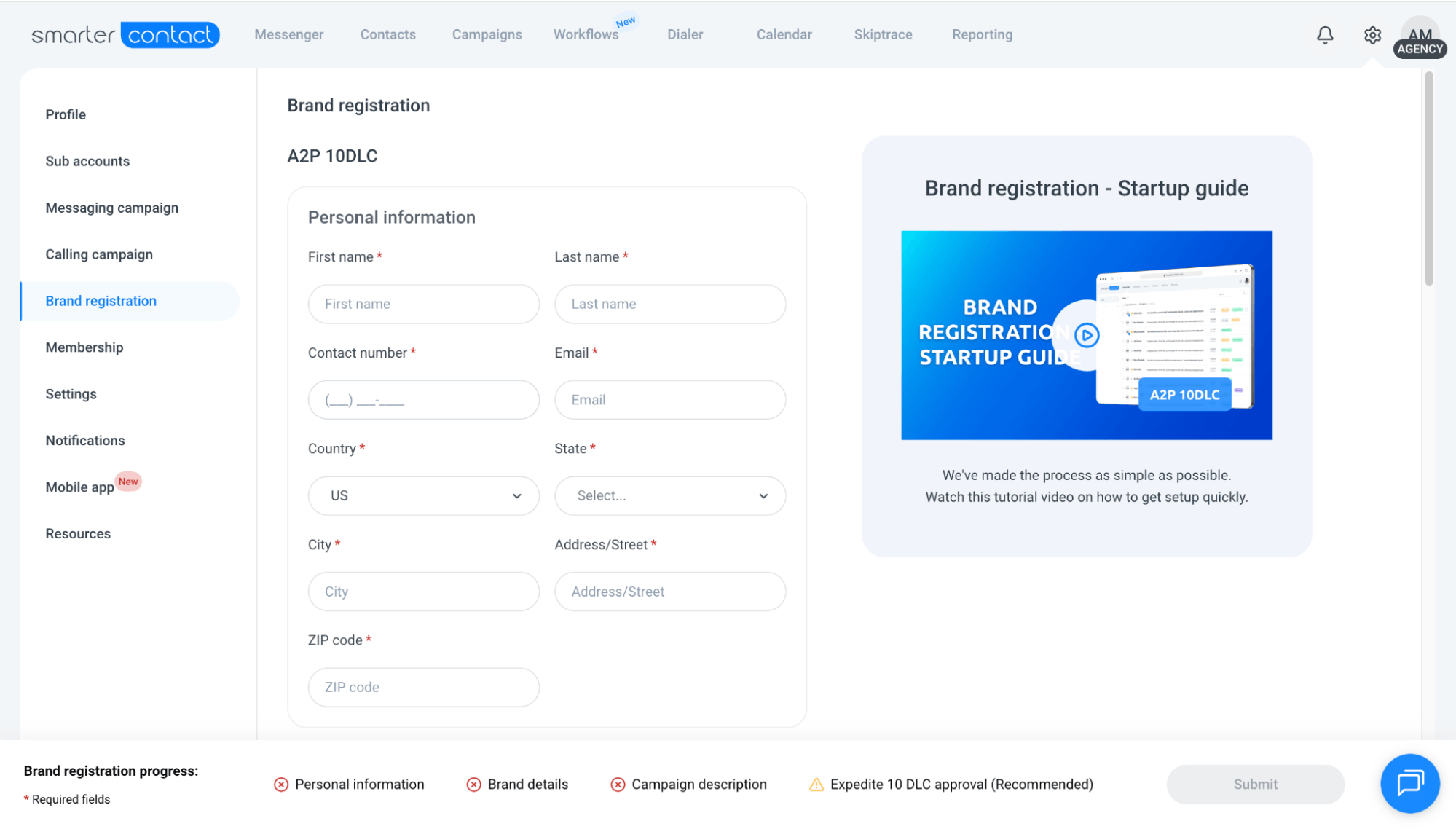
Since February 1, 2025, US carriers have blocked unregistered A2P 10DLC traffic outright. Registration has two parts: a brand, which identifies your business by EIN, and a campaign, which describes what you send and why.
During brand registration, The Campaign Registry scores your business, and that score decides which sending tier you land in. It affects campaign vetting, how fast you can send, how much you can send per day, and how aggressively carriers filter you. Scores come back low for predictable reasons: details that do not match your official records, such as an address that differs from the one tied to your EIN, or a limited business footprint, since smaller organizations tend to score lower.
If you operate multiple entities, this is the detail that catches teams by surprise. Registration is per EIN, so separate LLCs need separate brands, each with its own registration, its own tier, and its own volume allowance.
This is where platform architecture matters more than any feature. A tool that assumes one business per login forces you into separate accounts, separate logins, and separate reporting for each entity. A tool built for multiple brands lets you keep each registration distinct while working across all of them from one place. If you run more than one entity now, or expect to, ask about this before anything else on the feature list.
How many texts can you actually send per day?
Fewer than the number on the pricing page, and the constraint comes from carriers rather than your vendor.
Two limits apply, and they work differently. Throughput controls how fast you can send. Separately, carriers cap how much you can send in a day.
Both are assigned by tier, and the tier comes from your brand registration rather than your subscription. At the entry tier you send around 6 messages per minute, which works out to roughly 5,000 a day. The next two tiers run at about 26 and 102 per minute, or roughly 20,000 and 80,000 a day. A fourth tier sits well above that, but it is reserved for large publicly listed companies and will not apply to most real estate businesses.
Those daily figures assume a normal spread of carriers across your list. Individual carriers set their own ceilings, so a list weighted heavily toward one of them will run out sooner. Treat the numbers as a planning range rather than a guarantee, and note that two teams paying for identical plans can have very different real capacity.
Two things follow from this. Segments are not messages: anything over 160 characters, or containing emoji and certain punctuation, counts as more than one, so a 300-character text consumes twice the allowance of a 150-character one.
More importantly, the cap is applied per EIN and shared across every campaign under that brand. Running two vendors on the same EIN splits one allowance rather than doubling it, and once you hit the ceiling, messages fail until the counter resets. If you operate several entities, how your platform handles multiple brands directly determines your ceiling.
What does TCPA compliance require right now?
The TCPA governs consent for marketing calls and texts, and it carries statutory damages per violation, which is why a single non-compliant campaign to a large list can produce serious liability.
Two recent developments matter for anyone evaluating platforms in 2026:
The FCC’s one-to-one consent rule was vacated by the Eleventh Circuit in January 2025 in Insurance Marketing Coalition v. FCC, and the FCC subsequently issued a final rule removing it. The industry now operates under the broader pre-existing framework, where a single lead form can support consent covering multiple sellers provided the disclosure is clear and conspicuous.
Revocation rules are stricter and partly delayed. Businesses must allow consumers to revoke consent in any reasonable manner, honor that revocation within ten days, and send at most one clarification message afterward. The broader “revoke-all” requirement, which would treat a revocation of one message type as applying to all future calls and texts from that sender on unrelated matters, was extended again in January 2026 and now takes effect January 31, 2027.
Rules change. Your platform should absorb that change rather than pass it to you. This is not legal advice. Consent requirements vary by message content, by how each contact entered your list, and by state, so confirm your specific use case with counsel before you launch.
Does your SMS platform need to connect to a CRM?
Answer this before you compare integrations, because for a lot of teams the answer is no.
If you are one or two people, a messaging platform with a built-in contact record, labels for organizing where each contact stands, and full conversation history can serve as your CRM outright. Every message, label change, and note lives in the same place you work all day. You avoid integration setup, avoid paying for a second subscription, and avoid the class of problems where two systems disagree about the same contact. Adding a separate CRM at this size usually creates work rather than removing it.
If you are a larger team, or you already run a CRM that other parts of the business depend on, the messaging platform becomes a channel feeding that system of record. Then the connection matters, and it is worth understanding what kind you are getting.
There are two kinds of connection, and the difference is worth understanding before you compare vendors.
Native integrations are built specifically for one partner tool. Because the two products are designed against each other, they can move records in both directions: contacts flow into the messaging platform, you work them there, and statuses push back to the CRM. If the tool you already use has a native integration, that is almost always the better path. Check the partner’s plan requirements as well as your own, since two-way sync is sometimes gated on their side rather than yours.
Automation-layer connections through Zapier or similar cover everything else. They are flexible and work with nearly any CRM, and they generally push in one direction: contacts and replies flow out of the messaging platform into your system of record. For most teams that is enough, since the job is keeping your pipeline populated and your history visible.
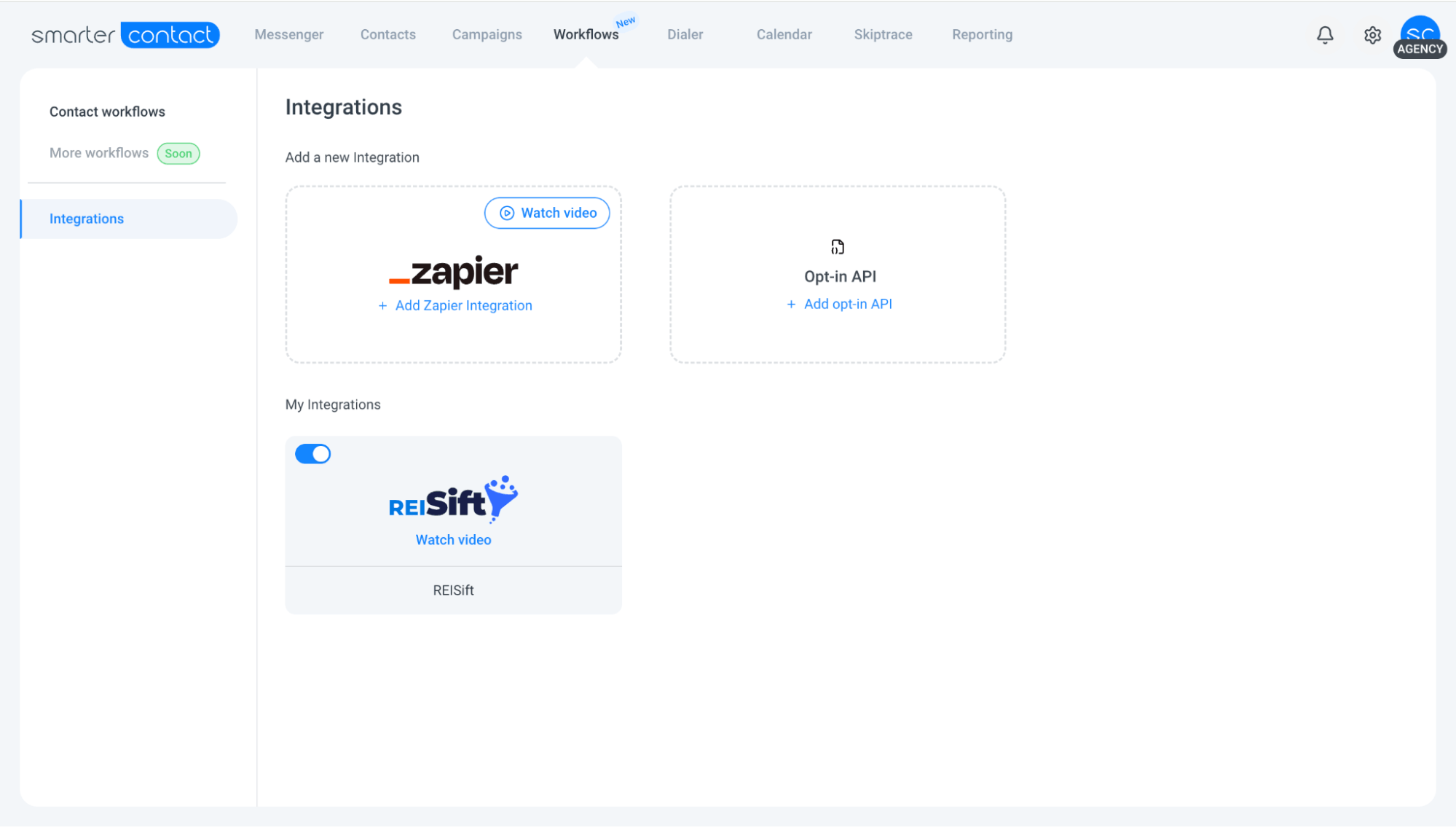
Either way, opt-outs deserve a specific question. If someone replies STOP, that needs to be reflected wherever your team works, so nobody adds them back to a future campaign. Ask any vendor how that propagates rather than assuming it does.
Three questions worth asking before you commit:
- Do you have a native integration with the tool I already use, or would this run through Zapier?
- When a contact opts out, what happens in my CRM, and how quickly?
- If I later move my contacts into a separate CRM, how much of my message history comes with them?
What does real estate SMS software cost?
Subscription is the visible cost. It is usually not the largest one.
Budget for four layers:
Platform subscription. Entry tiers for real estate specific tools generally start in the low hundreds per month, with volume tiers well above that.
Per-message or per-segment charges. Often billed separately from the subscription, and calculated per segment rather than per message.
Registration and carrier fees. Brand registration, campaign vetting, recurring monthly campaign fees, and per-message carrier surcharges. These are pass-through costs set by The Campaign Registry and the carriers rather than by your vendor. Several of these fees increased in August 2025, and exact amounts vary by brand, use case, campaign type, and provider. Rejected campaigns that need resubmission incur vetting fees again.
Data enrichment. Priced per record, and at volume it can rival the subscription.
The useful comparison is not the monthly price. It is the total cost per conversation started, which depends on deliverability as much as on rates. A cheaper platform that lands fewer messages costs more per conversation.
How do you evaluate deliverability before you commit?
Deliverability is the hardest thing to verify and the thing that matters most. Vendor-published delivery percentages are self-reported and rarely comparable, since definitions of “delivered” differ.
Better questions to ask a vendor directly:
- What sending tier do brands registered through you typically land in, and what do you do when one comes back low?
- How do you handle number rotation, and how many numbers come with my plan?
- Can I see delivery rates broken out by carrier rather than one blended number?
- What happens when a number gets flagged? Who notices, and how fast is it replaced?
- If I run multiple EINs, how does the platform separate brands and campaigns?
Then run a paid pilot on a real list before committing annually. Deliverability claims are cheap. Delivery data from your own list is not.
Five mistakes that get real estate numbers flagged
- Sending identical messages at volume. Carriers pattern-match. Merge fields and message variation are protective, not cosmetic.
- Including a link in the first message. Shortened links in a first-touch text are among the strongest spam signals carriers look for.
- Ignoring the daily cap. Hitting the ceiling repeatedly harms reputation beyond the failed messages themselves.
- Slow opt-out processing. Continuing to text someone after they replied STOP creates both carrier and legal exposure.
- Texting outside permitted hours. The time zone is determined by the recipient, not by your office.
Which platform should you choose?
The honest answer depends on what your bottleneck is. Below is where each of the commonly considered options fits best.
| Platform | Best suited for |
| Smarter Contact | Teams running SMS as their primary channel who want messaging, a power dialer, data enrichment, and contact management in one system. Multi-brand support and sub-accounts suit operators running several entities or separate books of business under one subscription. Also serves as the system of record for teams too small to want a separate CRM. |
| Lead Sherpa | Teams whose priority is data accuracy and compliance depth. SMS requires bringing your own 10DLC-approved Twilio account, so you manage that vendor relationship and registration yourself rather than having it handled for you. |
| BatchLeads (PropStream) | Teams whose first problem is finding and filtering property data rather than contacting owners. SMS campaigns require connecting a third-party provider, and the July 2025 PropStream acquisition leaves some open questions about how the two products converge. |
| REI Reply | Solo operators and small teams wanting the broadest all-in-one tooling, including AI voice, at the lowest entry price. The independent review footprint is thinner than others here, so weigh the breadth against less outside verification. |
| Roor | Operators who want number rotation and deliverability tuning as the platform’s central focus. The approach is narrower than the all-in-one tools here, so expect to pair it with separate systems for pipeline and data. |
| Twilio (DIY) | Teams with engineering capacity who want full control and the lowest per-message cost, and who will manage registration and build the interface themselves. |
A practical way to narrow the list: if your bottleneck is finding owners, start with a data-first tool. If it is contacting them at volume without getting filtered, start with a messaging-first platform. If it is your team drowning in replies, prioritize inbox organization and CRM features over raw sending capability.
Frequently asked questions
Do I need an EIN to send business texts? Practically, yes. Sole proprietor registration exists but comes with substantially lower throughput and volume allowances, which makes it unworkable for most teams sending at real volume.
How long does A2P 10DLC registration take? Brand registration is often quick, but campaign review is the variable. Plan for one to several weeks and register before you need to send, not after.
What consent do I need before texting a contact? Marketing messages require prior express consent under the TCPA, and the specific standard depends on your message content and applicable state law. Your platform should let you record where and when each contact consented, because that record is what protects you if a complaint arises. Confirm your requirements with counsel rather than relying on a vendor’s general compliance claims.
What is a message segment? A single SMS unit of up to 160 standard characters. Longer messages, and messages containing emoji or certain special characters, split into multiple segments, each counting separately toward carrier limits and per-message billing.
Why did my messages stop sending mid-campaign? Most often you reach a carrier daily cap. Caps reset each night and are shared across all campaigns under your EIN, so a single busy campaign can consume the allowance the rest of your sending depends on. Your ceiling depends on your registration tier rather than your subscription, so upgrading a plan does not raise it.
Do I need a separate registration for each of my LLCs? Yes. Brand registration is tied to an EIN, so each entity requires its own brand, and daily volume limits apply per brand rather than per company group. Practically, this means your total sending capacity scales with the number of registered entities you run, which is why multi-brand teams should check how a platform handles separate registrations before committing.
Can I switch platforms without losing my registration? Your brand registration belongs to your business, but campaigns are provisioned through a specific provider. Ask any vendor you are considering how migration works before you sign.
Still narrowing your list? The fastest way to find out whether a platform fits is to ask it the questions above directly. Book a call with the Smarter Contact team and put ours to the test.