You can write the perfect message to the perfect homeowner and still never reach them.
That is the part most real estate teams learn the expensive way. Message quality is not what decides whether a text lands in 2026. Carrier registration, number reputation, and opt-out handling decide it, and those live inside your platform rather than inside your copy.
This is a practical breakdown of the features that actually change results, what to verify before you sign anything, and what breaks when a feature is missing.
What changed going into 2026
Three shifts reset the bar for real estate teams.
Registration is now a hard gate. Since February 1, 2025, unregistered A2P traffic sent from 10-digit numbers is blocked outright rather than filtered or delayed. There is no grace period. If your brand and campaigns are not registered with The Campaign Registry, your messages are not arriving, and you will often see no error to tell you so.
Opt-out obligations tightened. Under the FCC’s 2024 TCPA Consent Order, a contact can revoke consent using any reasonable method, and the words stop, quit, end, revoke, opt out, cancel, and unsubscribe are treated as definitive on their own. You have 10 business days to process the request. One piece of that order, the “revoke-all” provision at 47 C.F.R. § 64.1200(a)(10), was delayed again in January 2026 and is now on hold until January 31, 2027 while the FCC decides whether to narrow it or drop it. Everything else is already in force.
Use case separation is enforced. Carriers match live message content against your registered campaign samples. Mixing property acquisition messages, appointment reminders, and promotional sends under a single registration is one of the most common causes of post-approval filtering and brand suspension.
None of that is copywriting. All of it is a platform.
1. A2P 10DLC registration handled inside the platform
Brand registration and campaign registration are the entry ticket to U.S. messaging at any volume. The question is not whether a platform supports it. The question is how much of it you have to do yourself.
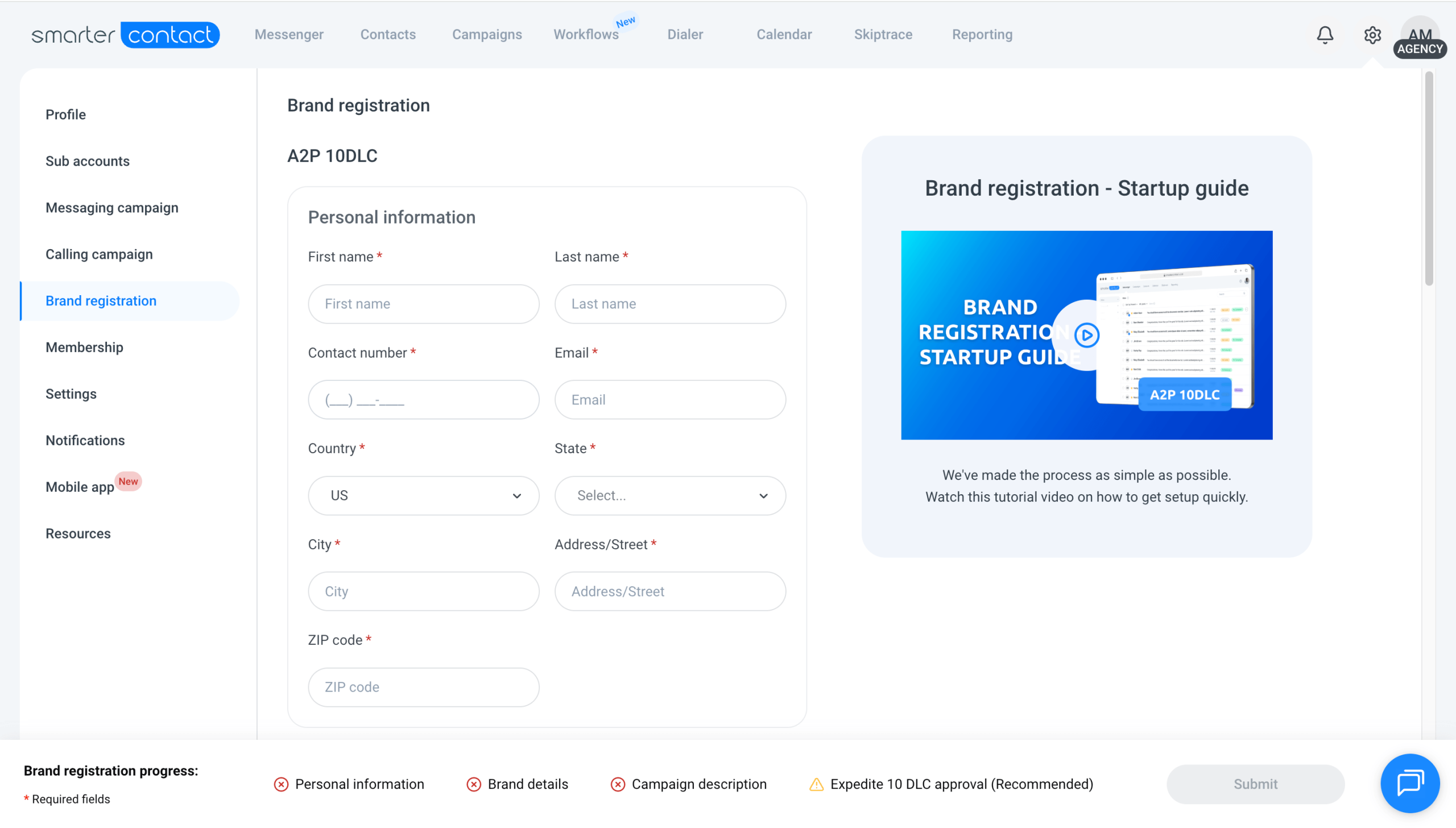
Look for a platform that submits your brand and campaigns to The Campaign Registry from inside the app, with visible status at each stage. Ask what happens when a campaign is rejected, because rejections are common and the most frequent cause is a website that does not carry the required privacy policy and consent language.
Verify: in-app registration flow, status visibility, rejection support, and what registration actually costs you.
Risk if missing: silent non-delivery. You keep paying for sends that never reach a mobile phone.
2. Automatic suppression, including litigator scrubbing
Every platform claims opt-out handling. The gap is in coverage.
A real suppression system tracks more than replies to your messages. It should cover federal and internal Do Not Call entries, contacts who opted out, contacts flagged as known litigators, numbers the carrier has blocked, addresses that repeatedly fail delivery, and contacts caught by content filtering. Suppression should apply account-wide and instantly, not per campaign.
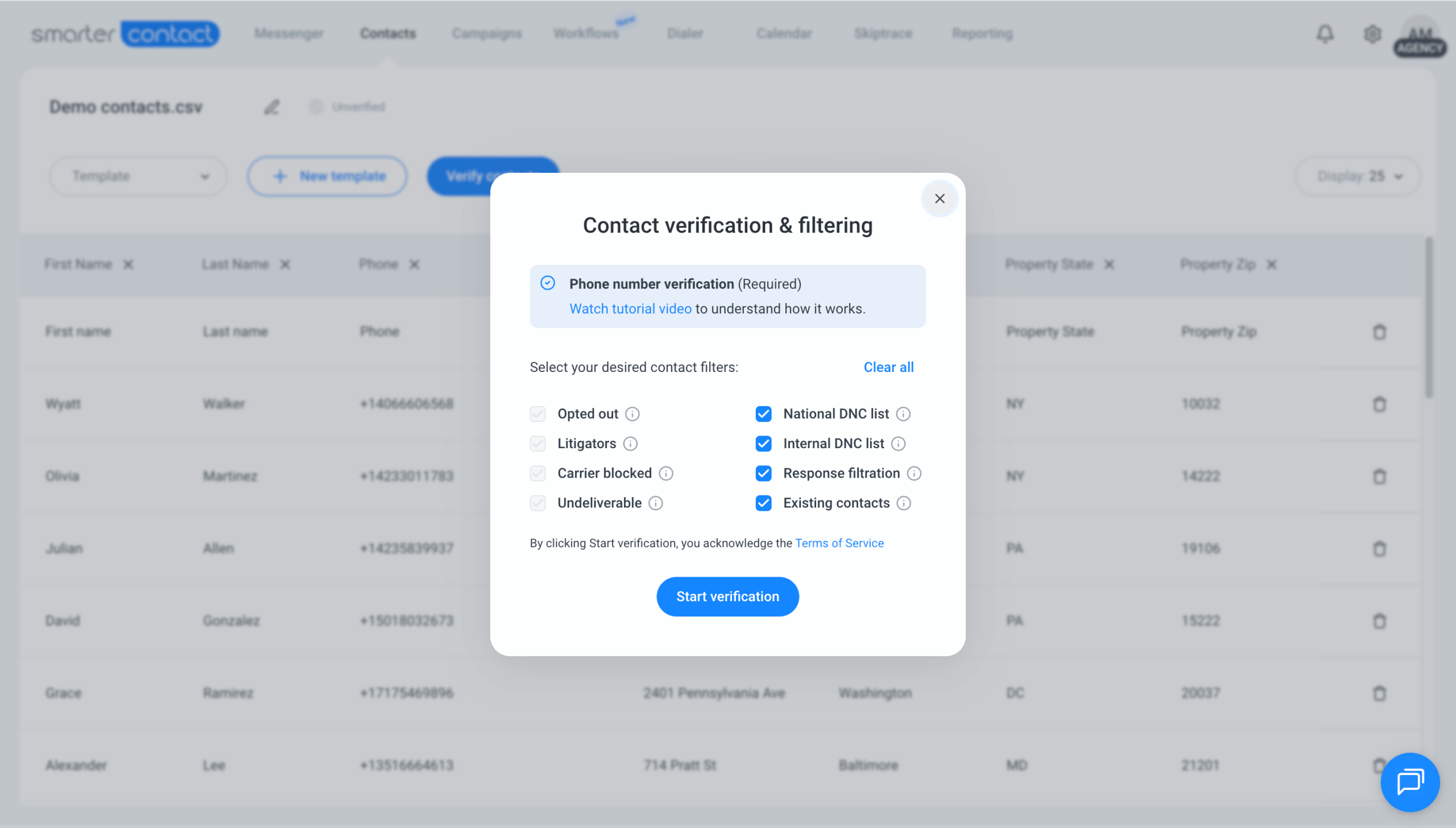
Litigator scrubbing deserves specific attention in real estate. Courts have allowed TCPA claims to proceed over messages offering to buy a home, reasoning that the sender’s purpose was to route the owner toward paid services. A single claim can cost more than a year of platform fees.
Verify: suppression categories, whether they apply across all sub-accounts, and how quickly an opt-out propagates.
Risk if missing: direct legal exposure, plus carrier penalties for a rising opt-out rate.
3. Number reputation management
Carriers score your phone numbers. Poor scores produce spam labels, filtering, and blocked traffic, and the damage takes weeks to undo.
Reputation is built by volume discipline. New numbers need a warmup period where daily volume climbs in stages. Heavily used numbers need cooldown time. Numbers should rotate across a campaign rather than carrying all of it. Teams sending to larger contact groups need multiple outbound numbers as a baseline, not as an upgrade.
A platform that leaves this to you is asking you to manage carrier relationships manually.
Verify: automatic warmup stages, configurable cooldown, number rotation inside campaigns, and spam label monitoring.
Risk if missing: a burned number pool and a rebuild cycle measured in months.
4. Data Enrichment with property-level detail
Generic contact data is a commodity. Property data is not.
For real estate teams, Data Enrichment should return phone numbers, already sorted into mobile and landline, along with email addresses and the property details that tie a contact to a specific property: the parcel number assigned by the county assessor, the county, and the state.
That detail is what separates a relevant message from a generic one. Knowing the line type also keeps you from spending a send on a number that was never going to receive a text. Relevant messages get replies. Irrelevant ones get opt-outs.
Verify: which property fields are returned, whether line type is identified, match rate, per-record pricing, and whether enrichment runs inside the platform or requires an export and re-import.
Risk if missing: you message the wrong property owner with the wrong offer, or waste a send on a landline that could never receive it, and you pay for it in opt-outs.
5. Drip campaigns for structured follow-up
Most real estate conversations do not start on the first message. They start somewhere in the follow-up.
A drip campaign sends a defined sequence over time, with configurable intervals between steps. What matters is the control you get: how many steps you can build, whether the sequence stops automatically when someone replies, and whether you can branch based on response.
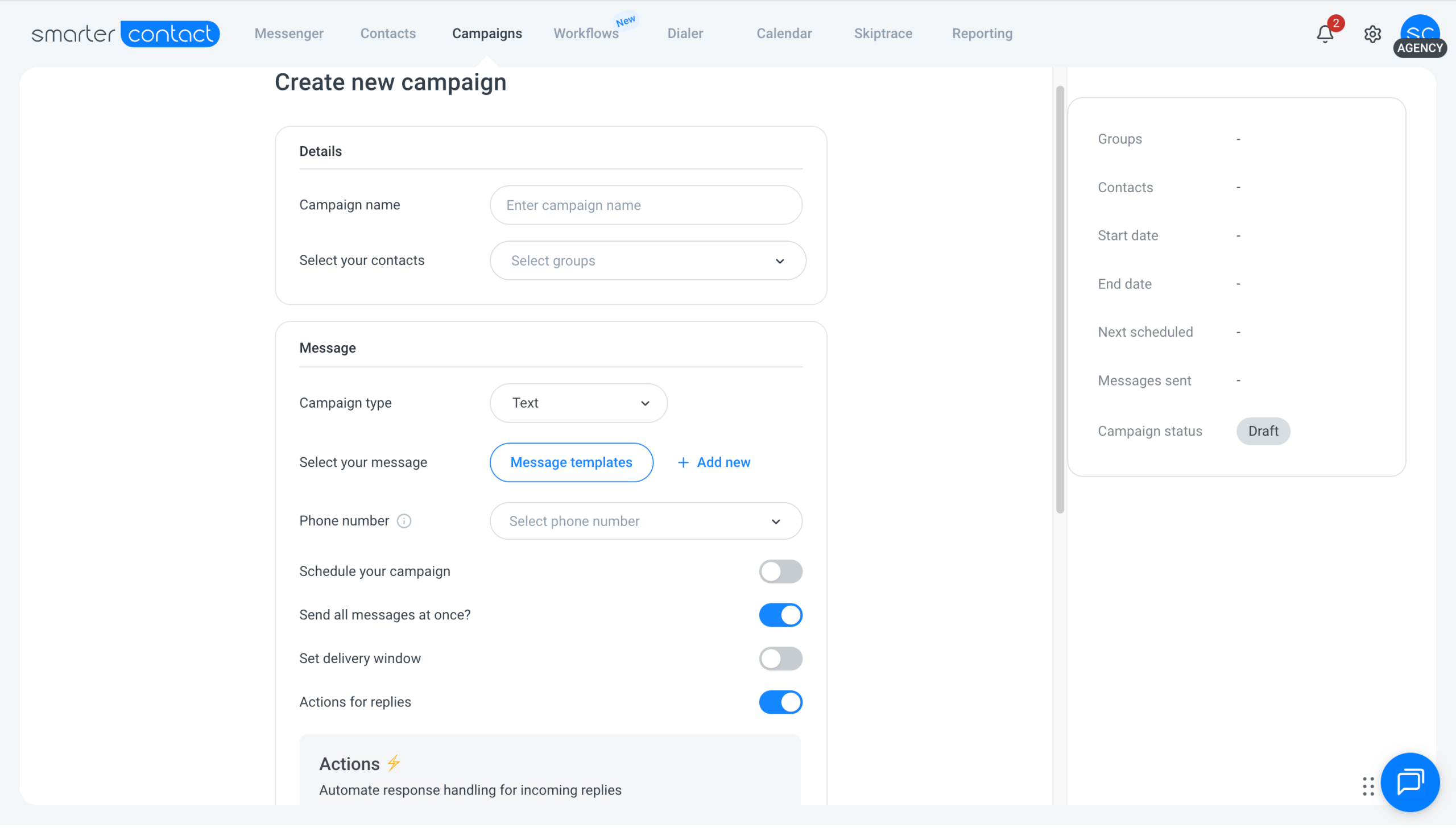
Check the interval logic carefully. Sequences that fire too tightly read as automated and get reported. Sequences with sensible spacing read as persistence.
Verify: maximum sequence length, auto-stop on reply, business hours enforcement per step, and time zone handling across a national contact list.
Risk if missing: manual follow-up that quietly stops after the second touch.
6. Contact Workflows and behavior-triggered automation
Drip campaigns run on a clock. Workflows run on behavior.
A workflow triggers when something happens: a contact replies, a call goes unanswered, a tag changes, a form is submitted. It then routes that contact into the right sequence, assigns them to an agent, updates their group, or fires a notification.
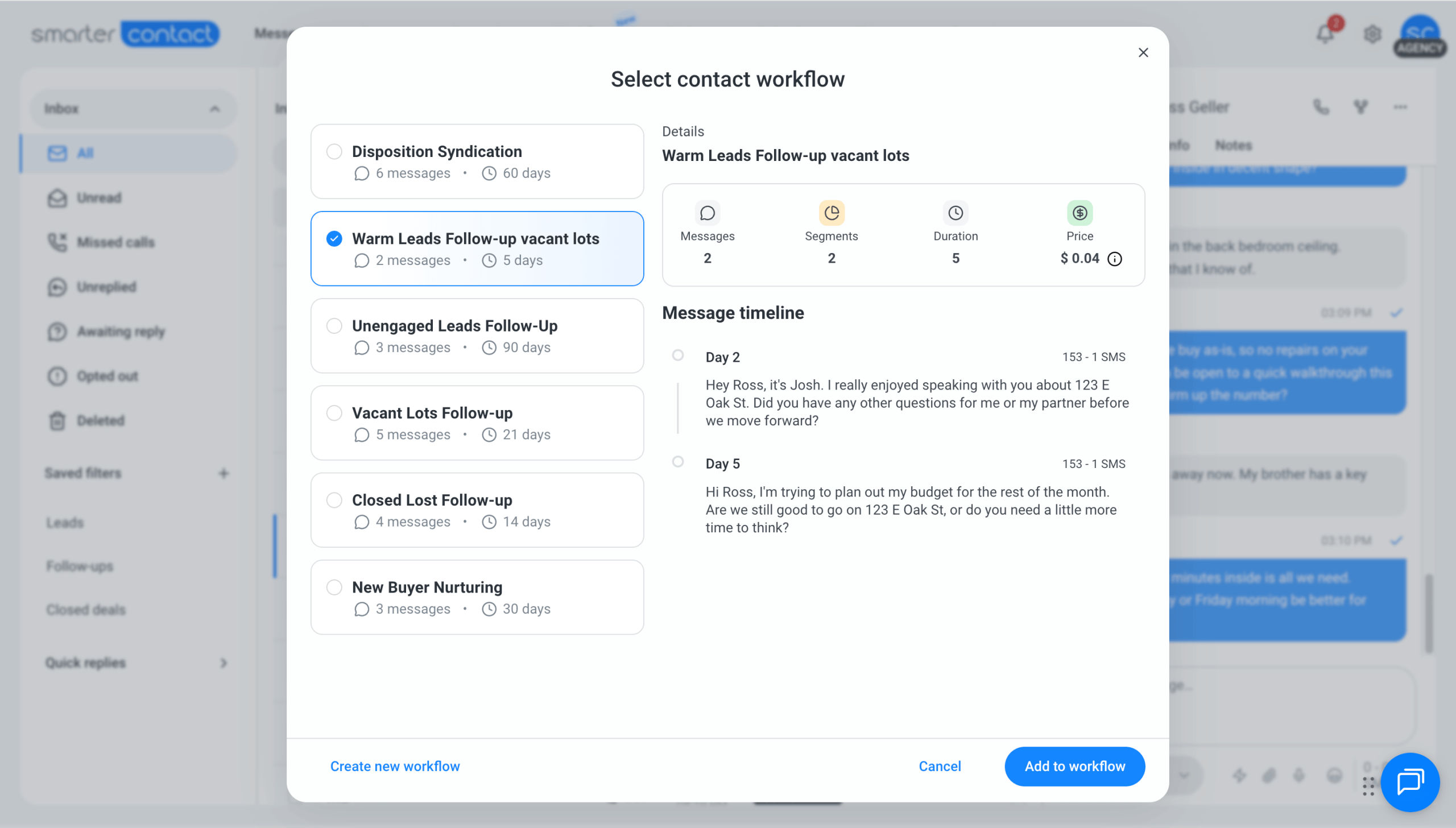
This is the feature that scales a team past one person. It is also the feature most commonly demoed and least commonly used, so ask to see a workflow built live rather than a pre-configured example.
Verify: available triggers, available actions, branching support, and how workflows interact with suppression.
Risk if missing: your automation is a calendar, not a system.
7. Calling and voice in the same platform
Texting alone often leaves conversations unfinished. The real estate teams that close deals are texting and calling the same contact from the same record.
A power dialer places calls automatically and only connects an agent once a real person answers, with answering machine detection sorting each pickup as a person or a machine, tunable for speed or accuracy. Teams also need the option to place a one-to-one call to a contact directly, outside the automated sequence, for conversations that call for a more personal touch.
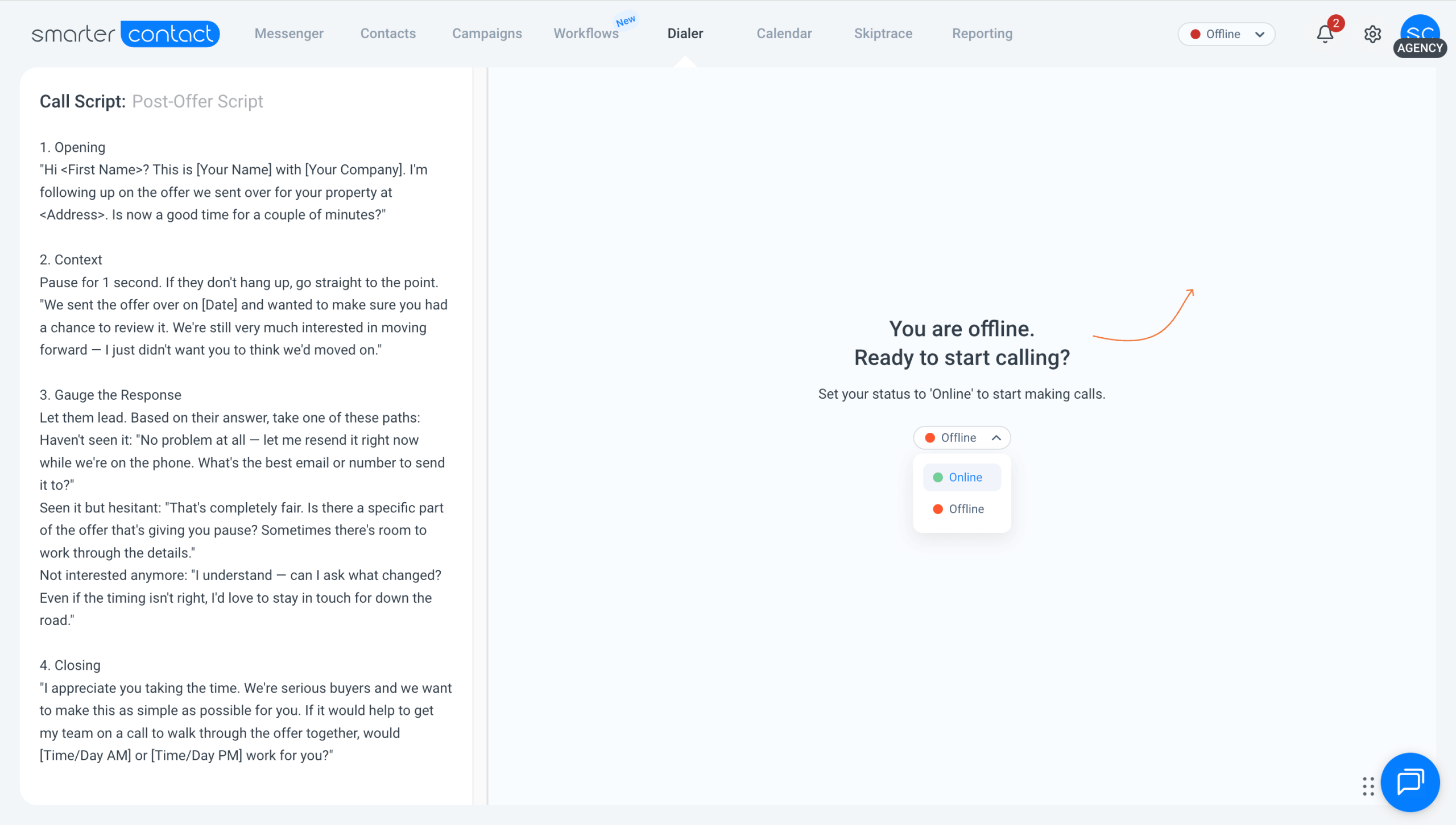
Voice doesn’t have to mean a live call, either. Ringless voicemail drops a pre-recorded message straight into a contact’s voicemail without their phone ever ringing. A separate voice message option lets you send a short recorded voice note to a contact without placing a call at all.
If calling and voice run on a separate tool, you end up with separate suppression lists, separate reports, and two systems that can disagree about whether someone opted out. That disagreement is a compliance risk, not just an inconvenience.
Verify: automated and one-to-one dialing, answering machine detection settings, ringless voicemail and voice message support, and shared suppression across every channel.
Risk if missing: you lose the contacts who never answer a text but will pick up a phone call.
8. A shared conversation view for replies
Campaigns create replies. Replies create revenue or they die in a queue.
Whatever the platform calls it, judge the conversation view like a shared workspace. Can multiple agents work the same threads? Can you filter by unread, unreplied, and awaiting response? Are there saved quick-reply phrases so agents answer consistently? And is ownership clear enough that two people don’t respond to the same seller?
Test this on a phone. Most reply handling happens between showings.
Verify: multi-agent access, filter categories, canned message support, mobile parity, and reply notification speed.
Risk if missing: slow replies, and a seller who has already spoken to someone else.
9. Consent capture
Data Enrichment tells you how to reach an owner. Consent tells you what you’re allowed to send. Two different questions.
Some of the ways to collect it:
Inbound keyword campaigns. Someone texts a word to your number after seeing it on a sign, a listing, a mailer, or an ad. Their message opens the conversation and the keyword timestamps it. This only works inbound: the contact has to text you first.
Opt-in API. Consent captured on your own site or ad platform and written straight to the contact record with the source and timestamp attached. Where the form carries a clear and conspicuous disclosure, this is the cleanest written consent available to you.
Existing relationship. Someone who called you, submitted a form, or replied to a mailer has handed you their number for a reason. That consent is real, but it is scoped to the reason they gave it. It does not extend to unrelated campaigns.
Verify: that keyword campaigns are inbound-only with no outbound prompt, Opt-in API availability, how timestamps and capture sources are stored, and whether you can export a consent record for a single contact.
Risk if missing: no consent record you can export and defend.
10. Sub-accounts and permissions
Sub-accounts under a primary account let each person hold their own numbers, contacts, and campaigns while you keep control of settings, spend, and compliance.
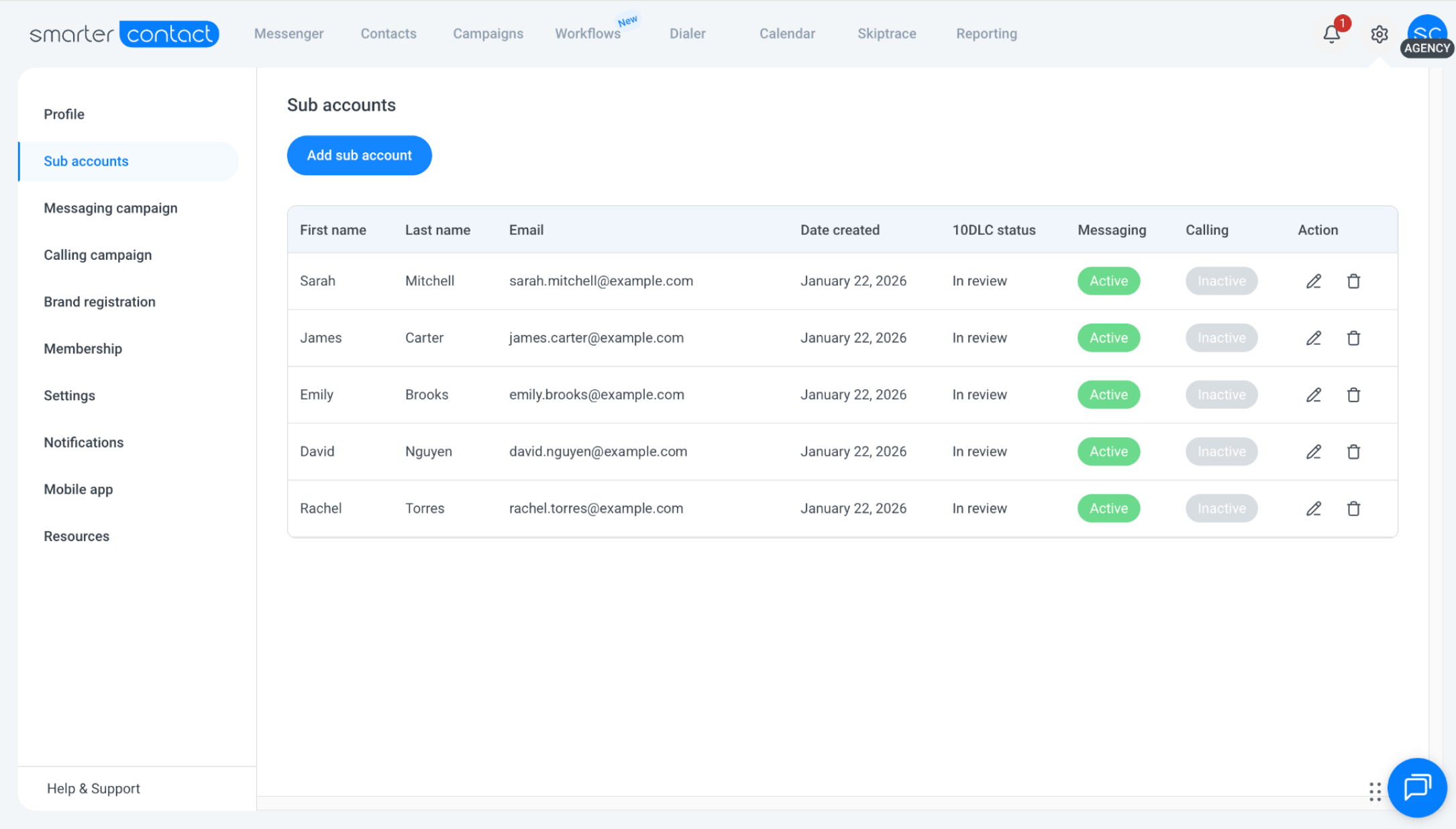
Number distribution is the part to scrutinize. Reputation attaches to individual numbers, so separate numbers mean one person’s sending doesn’t drag down everyone’s deliverability.
Suppression is the exception that stays global: an opt-out in one sub-account applies to all of them.
Verify: permission granularity, number assignment and reassignment, cross-account suppression, and what happens to a departing user’s conversations.
Risk if missing: one person’s sending degrades deliverability for the whole team, with no way to see who caused it.
11. Reporting
Delivery rate means the carrier accepted the message. That’s all it means.
Four numbers carry information: reply rate, opt-out rate, carrier block rate, and whether conversations turned into deals. Break each out by campaign, by number, and by team member.
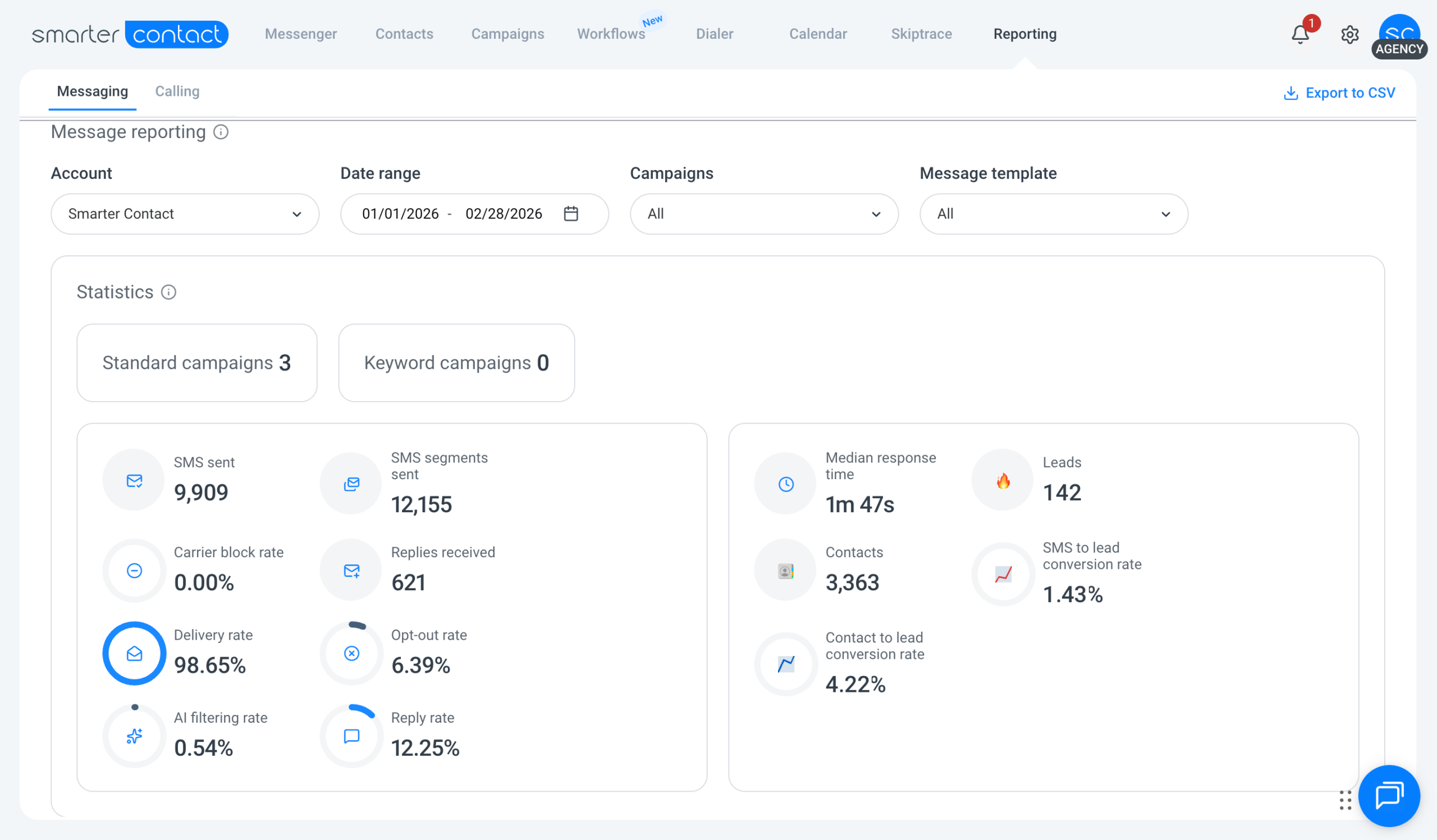
Opt-out rate per number climbs before carrier filtering shows up, and an account-wide average hides a single degrading number.
Verify: segmentation by campaign, number, and team member; trend view over time; raw data export.
Risk if missing: a failing number stays hidden inside the account average until carriers act on it.
Quick evaluation table
| Feature | What to verify | Risk if missing |
|---|---|---|
| A2P 10DLC registration | In-app submission, status visibility, rejection support | Messages blocked with no error |
| Suppression and litigator scrubbing | Category coverage, account-wide propagation | TCPA exposure, carrier penalties |
| Number reputation management | Warmup, cooldown, rotation, spam label monitoring | Burned numbers, months to rebuild |
| Data Enrichment | Property fields returned, match rate, in-app workflow | Irrelevant messages, high opt-out rate |
| Drip campaigns | Sequence length, auto-stop on reply, time zones | Follow-up stalls after the second touch |
| Contact Workflows | Trigger and action range, branching | Automation that cannot react |
| Dialer and voice | Dial modes, answering machine detection, shared suppression | Contacting people who opted out |
| Shared conversation view | Multi-agent access, filters, mobile parity | Slow replies, duplicate responses |
| Consent capture | Opt-in API, Existing Relationships… | No provable consent record |
| Sub-accounts and permissions | Permission granularity, number assignment, cross-account suppression | One account degrades deliverability for all |
| Reporting | Segmentation by campaign, number, and team member; export | A failing number hides in the average |
Four questions to ask on a demo
- Who submits my brand to The Campaign Registry, and what is your current average approval time for a real estate brand?
- When a contact replies with an opt-out keyword, what happens across every channel and every sub-account, and how fast?
- Do you scrub against a litigator database, and is it included or an add-on?
- Show me the opt-out rate broken out by campaign and by phone number.
If a demo cannot answer all four, the platform is a messaging tool rather than a real estate messaging platform.
Frequently asked questions
Do real estate agents need 10DLC registration to text sellers? Yes. A2P 10DLC applies to any business sending automated or bulk SMS from 10-digit U.S. numbers, with no exception for company size or volume. Unregistered traffic is blocked by the major carriers.
What is the difference between an SMS platform and a CRM with texting built in? A CRM stores relationships. An SMS platform manages carrier compliance, number reputation, throughput, and suppression. Most CRM texting add-ons handle the first and very little of the rest, which is why teams running volume typically use both.
How many phone numbers does a real estate team need? It depends on contact volume and carrier throughput. Larger contact groups generally require multiple outbound numbers so no single number carries the full load. Ask any platform what its minimum is for your list size before you buy.
Is Data Enrichment the same as buying a contact list? No. Enrichment fills in missing details on records you already have, such as a phone number or parcel data for a known address. A purchased list is contacts you have no relationship with, which creates a consent problem before you send anything.
What happens when someone replies STOP? The platform must suppress that contact and stop all further messages. Under the FCC’s rules, stop and several similar words are treated as definitive revocation on their own, and you have 10 business days to process the request. A good platform does it instantly and applies it account-wide.
Can one platform handle both texting and calling? Yes, and it is worth prioritizing. Running both channels in one system means one contact record, one suppression list, and one set of reporting. Split systems eventually disagree about consent.
Where to go from here
The same idea runs through all eleven features: the message you write isn’t what decides whether you texting works. What happens before you send it, and what happens after, is what decides it. Either your platform handles that work, or you do.
Smarter Contact was built for this vertical specifically. A2P 10DLC registration runs inside the app. Suppression covers Do Not Call, opt-outs, litigators, and carrier blocks account-wide. Data Enrichment returns property-level detail. Campaigns, Drip Campaigns, Contact Workflows, the Power Dialer, and reply handling all run against the same contact record, so consent and reputation stay consistent across every channel.
If you are evaluating options, take the five demo questions above into every conversation you have, including ours.